Cape Town

The web alter-ego of Colin Hunter

With the RS4 being direct petrol injection into the combustion chamber, FSI (Fuel Stratified Injection) in Audi-land, the oil laden vapours from the crankcase recycled for emission reduction hit the hot inlet tract and valve and deposit a gooey buildup on the inlet tract and valve stem and eventually become hard carbon deposits because there is no petrol washing over the valve as there would be with a carburettor, or manifold fuel injection, which along with the additives in the petrol kept all of this clean. So, with the RS4 having passed the 100K km mark, it was time for a ‘carbon clean’. I had noticed uneven idling and the engine hunting at low speeds around town making it a little hard to drive smoothly – definite signs a clean is needed.
So, what’s involved? There are some snake-oil solutions out there, so tread with caution. If done regularly, the gooey deposits can be dissolved with foaming aerosol can cleaners injected into the inlet manifold, allowed to dissolve for half an hour or so and then consumed and expelled through combustion. I will do this annually now as I now know where there is a suitable injection point on the inlet manifold. However, this does not remove any hard carbon deposits. The only 100% solution is to remove the cylinder heads, but since this requires engine removal for the RS4, I didn’t want to go there. The intermediate solution is to remove the inlet manifold to get access to the inlet tracts and valves. This is nice and easy for your average wee car, but having a V8 shoehorned into a medium sized saloon car adds difficulty. I had to buy some specific tools to access fasteners at the back of the engine and fabricate a couple of special tools. After that, just some tight and fiddly dismantling.
For the cleaning, some go with foaming cleaner and lots of elbow-grease with scrapers and the like. Some use the foaming cleaner to remove the gooey stuff and then grit blasting to remove any hard deposits. I chose the latter option and went with ground walnut shell media as it is more environmentally friendly.

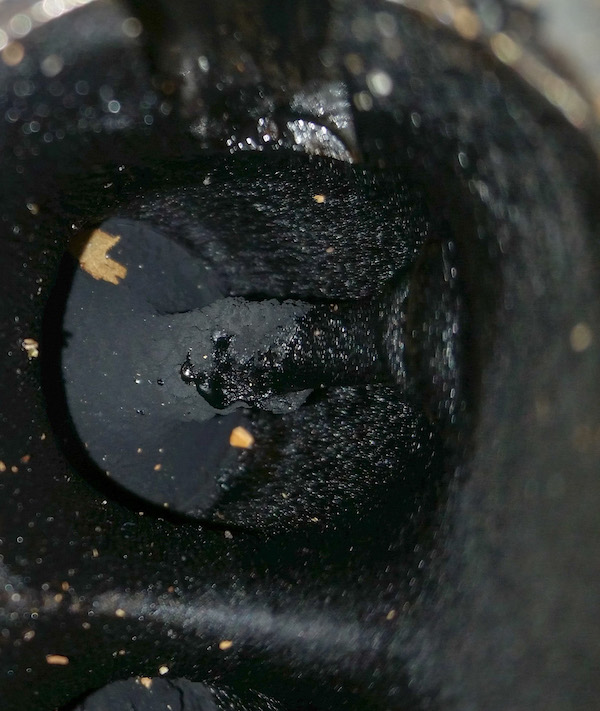
Inlet tract and valve stem with significant deposits – some bits of walnut shell visible.
I would visually ensure both valves were closed on as many inlets as possible and then squirt the foam cleaner in and leave for about half an hour. The foam has reduced to a liquid and using an old toothbrush the last of the gooey stuff could be brushed off and then soaked up and removed with paper towels. The next step was to use the crushed walnut shell media to remove the hard carbon. This became a lengthy drama, as the media was too large to fit through the grit-blasting gun and would clog up in seconds. After incremental modifications to the grit blasting gun over a couple of weekends, it would work most of the time, with only occasional blockages. Next time – buy finer walnut shell grit.

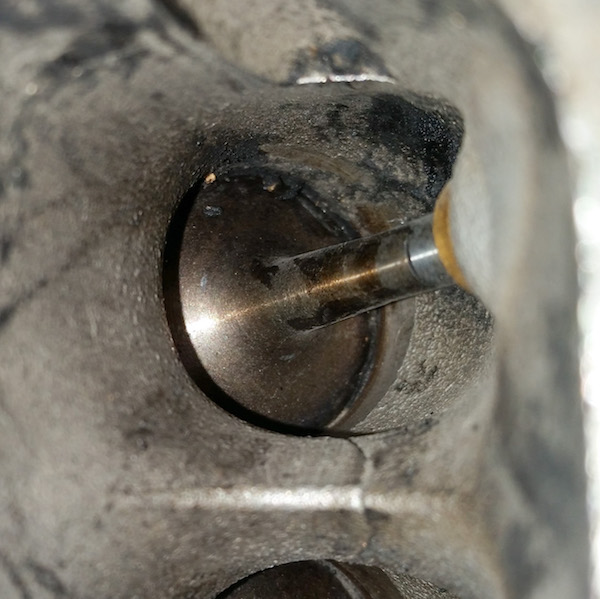
Inlet and valve after cleaning.
Well, all I can say is wow, what a difference. From being a pain at town speeds, it’s now super smooth.
I was back in the UK for a holiday over Easter and then another couple of weeks for work. I always like to get to the west coast if possible when I’m in Scotland. I like to get off the beaten track, so as always, I looked for some interesting accomodation. One thing there is no shortage of in this neck of the woods is lighthouses and after a wee search I found an ex lighthouse-keepers cottage at the Ardnamurchan Lighthouse available for rent for a week. It had 2 bedrooms, so was perfect for mum and I. We stayed with my sister in Glasgow on the Saturday and drove up there on Easter Sunday. Rather than the long drive, we took a slightly more relaxed approach and took the ferry from Oban to Craignure on Mull, short drive to Tobermory, ferry to Kilchoan on the Ardnamurchan peninsula and then an even shorter drive to the lighthouse.

The lighthouse was designed and built by Alan Stevenson, uncle of Robert Louis Stevenson, in 1849 from Mull pink granite. It was built in the Egyptian style popular at the time with features visible in the design of both the lighthouse and the keepers cottages.

The construction of the buildings is very solid with incredibly thick walls, so very cosy with the modern electric heating. We had picked up some lovely fresh fish and meat at Loch Fyne Oysters and a mini-cask of Jarl light ale from Fyne Ales, so enjoyed a few days of relaxed wandering, eating and drinking. Outdoor activities were limited by the brutally cold northerly wind, fine in a sunny sheltered spot, but too cold for comfort in the wind.
On Thursday morning we took the ferry back to Tobermory. I had booked us into the grand old Western Isles Hotel, which I vividly remember from childhood visits to Tobermory, standing high above Tobermory harbour. I had also booked us into one of my favourite restaurants that evening, the wonderful Cafe Fish. The name tells part of the story, but the fact that they have their own fishing trawler, Highlander, is the real story. It’s all about the freshest possible seasonal seafood, on your plate within a few hours of being landed. I intended going there for lunch too. I hadn’t told mum, but there was no arm-twisting required. After a great lunch we checked into the hotel. Mum’s room was awesome, but mine was that little bit more awesome with a raised sitting area in a large bay window looking out over the Sound of Mull – the Glenlivet Room for reference. The weather was, shall we say, moody, but the blossom brightened things up.

At dinner, we had the prime corner window table with a view out over Tobermory harbour. Dinner was fabulous, as fresh as seafood gets and in my opinion cold water seafood is somehow better, slower growing maybe.

Already looking forward to my next visit.
I have, somewhat inadvertently, outdone myself. Once again I had been to Hastings of a lunchtime to get something, I forget what, and on the way back to the office I stopped at Cafe Anatolia to pick up a kebab for lunch. The NZ Transport Agency send out reminders when your rego’ needs renewing, but after about 6 months of owning the vehicle I hadn’t received a reminder and hadn’t thought to check the sticker on the windscreen. Anyway, caught pants down, rego out by a couple of months. The seller in Auckland clearly hadn’t filled in the ownership transfer document, so NZTA would have given Hastings council their address. Shortly after they received the fine notice, I received the new ownership document and about a week later the unregistered vehicle fine arrived – thank you so much… The local council website indicates that you have to challenge the fine in court. I was technically guilty as charged, but with the extenuating circumstance that I had become complacent and relied on the reminders. Crazy busy as always up to Christmas, so didn’t look into it further and ended up paying the $200 fine at the last minute to avoid it escalating. Turns out I probably had good chance of getting the fine reversed if I had spent the time to present a reasonable excuse. Anyway, too late now, so the kebab ultimately cost $209.50, which trumps the $158 kebab back in 2009…
Just over a week ago I had my first flight on one of Air New Zealand’s new Boeing 787-9 Dreamliner’s. I had been at a conference in Sydney and flew out back to Auckland mid morning on the Friday. On some flights on this sector AirNZ use long-haul Aircraft, so 777-200/300, or Dreamliner, even though it is a short-haul flight. Just so happened I was on a Dreamliner. On these trans-Tasman and Pacific Islands short-haul routes Air NZ have basic ‘Seat’ and ‘Seat + Bag’ non-changeable options and ‘The Works’ and ‘Works Deluxe’ which are changeable and include food and entertainment in the price. The latter two options put you towards the front of the plane and ‘Deluxe’ guarantees an empty seat next to you on the single aisle Airbus A320. On the Dreamliner, ‘The Works’ puts you at the front of Economy, or in Premium Economy, and ‘Deluxe’ puts you in Business Premiere. I was on a ‘The Works’ ticket, changeable in case of a change of plans which has happened a few times, but I had an Elite short-haul recognition upgrade which bumped me into business. I normally fly long-haul from NZ, so it was nice to be able use a short-haul upgrade for a change. As a frequent flier, you can select your seats online in advance rather than just within the 24 hour online check-in period. So, my first flight on a Dreamliner was in seat ‘1A’.

The Business Premiere seats were developed for the 777-300 and then also used in the 747, now out of service with Air NZ, and 777-200 when they were overhauled, and now the Dreamliner. They don’t fit the Dreamliner as well as the other aircraft as it is seemingly a narrower body. Very comfortable nonetheless. Despite being called ‘Works Deluxe’, it is in fact the full Business Premiere service from long-haul. You get linen, crockery, metal cutlery, attentive service and food developed by Peter Gordon and his team – he has 2 or 3 restaurants in both Auckland and London. So, a 3 hour flight was more like a long lunch in a good restaurant, with fabulous food and excellent NZ wines. So, if you’re planning a trans-Tasman or Pacific Island flight with Air New Zealand, I recommend you check out which aircraft are available and book accordingly for a very pleasant experience over the regular bus trip in an appropriately named short-haul Airbus.
My present to myself this last Christmas was a PowerCRAFT TIG 200 AC/DC welder. It’s made by Lincoln Electric, one of the big US welder manufacturers. They are clearly competing against the widely available cheap Chinese welders and, whilst it is using their technology, it is manufactured in China. It can weld steel and stainless steel, as well as aluminium, magnesium, titanium and zinc, probably more.

Wow, over 2 years since my last post. Every so often, probably every few months, work becomes busier than ever, but it never gets less busy, so that’s the new norm until it gets busier again…
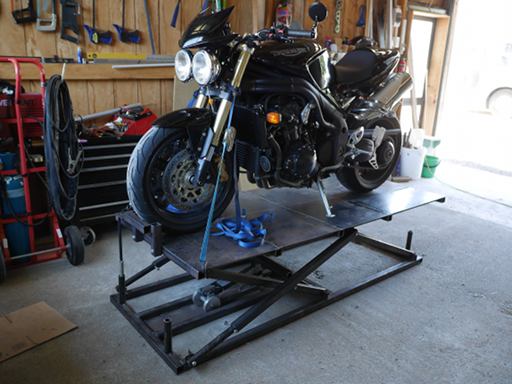
Anyway, my knees are not so good after years of crawling around on rocks manhandling seals when we were tagging them. I always take kneepads on the rare occasions I get into the field now. That also means I’m done with crawling around on my knees servicing my motorbikes, so I built a multipurpose bike-lift/workbench from scratch using a cheap trolley jack to lift it. The bench sits at 250mm when lowered and there is a ramp which clips on to run the bike up and down. For bike work it will only be lifted to 400mm, or 500mm, but the bench can be lifted to 900mm and locked at every 100mm increment in between. At 800mm, or 900mm it is a heavy duty bench for engine/gearbox work and a welding bench – earth the bench and for most welding jobs, contact is made through the bench.
It’s been built over a few months inbetween travel, but I’ve finished it during the Xmas/New Year break. I used my landlord’s industrial MIG welder for a lot of the structural stuff, not to mention his vertical milling machine for the precision drilling, as well as his metal bandsaw and guillotine. My Xmas treat to myself was a 200Amp AC/DC TIG welder which has been used to finish the job.

The picture shows the Speed Triple on the lift for a quick service, the ramp only fits when the table is fully lowered.
Wow, over a year since I last blogged. I have travelled a lot and a lot has changed since then. I guess I’ve just been really, really busy and will get to that, but not in this post.
So, I took the RR in for a Warrant of Fitness (WoF) and it failed with a couple of dead bulbs (I hope – haven’t checked yet) and an oil leak all over the nearside rear disk brake – the inner hub seal the only possibility. The WoF fail was on the Thursday afternoon before the Hawkes Bay Anniversary Friday annual holiday and Labour Day on the Monday. On the Friday morning I removed the hub to confirm the damaged seal, but all else intact. Nowhere in Hawkes Bay to buy a new seal until Tuesday being a holiday weekend.
So, the cunning plan. I had intended a trip around the East Cape in the S4 for a while and could get a seal in Gisborne (different region, no Friday holiday) if I was early enough. So, ‘carpe diem’. I booked accommodation in Gisborne and Opotiki online. I arrived in the nick of time in Gisborne to buy the $10 oil-seal from Eastland Bearings. I stayed at the Portside Hotel which I would definitely recommend. May be pricey at peak season, but it is quality accommodation.
Saturday proved to be as good as forecast, barely a cloud in the sky. I headed off first thing around the East Cape. A quick photo op’ at the Tolaga Bay wharf and then a breakfast at the Uawa Cafe, part of the amazing old Tolaga Bay Inn dating back to 1890.

The 600 m long Tolaga Bay Wharf
Next stop the East Cape lighthouse. An hour and a half of incredible twisty roads, virtually no traffic and not a cloud in the sky – doesn’t get much better. I had recently fitted 18″ wheels with Bridgestone Potenza RE002 tyres to replace the worn out imported Yokohama tyres on 19″ x 8.5″ wheels fitted when I bought the Audi a couple of years ago. 18″ x 8″ is the original size, and whilst not filling out the S4’s stretched guards as pleasingly as the previous combination, the taller profile tyres and rims within the width of the tyres is more practical and comfortable. And I must say ‘wow’! The grip is incredible, grippier than a grippy thing. To quote Clarkson and co. on Top Gear, it felt like my face was going to slide off. I’m sure my shiny new Samsung Galaxy S3 can measure the G-force and I’ll try that later. Definitely a huge improvement on the previous tyres. It was then a 20 km drive on a mostly unsealed road from State Highway 35 to the East Cape.
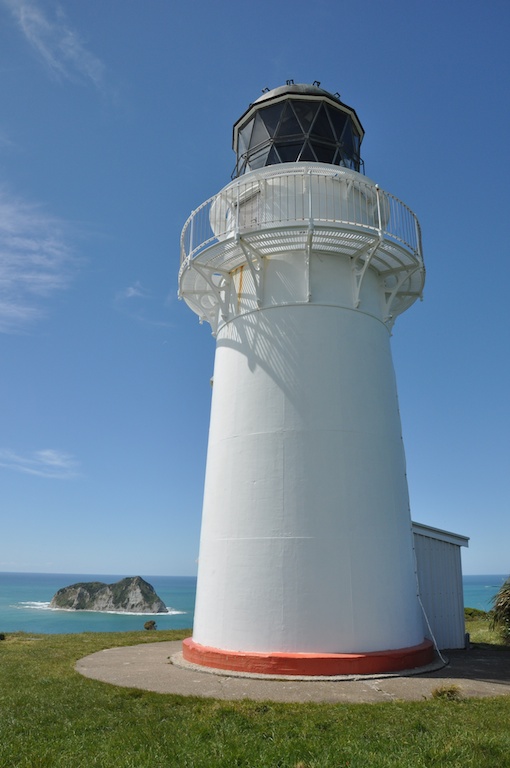
The East Cape lighthouse with the equally excitingly named East Island in the background
God I’m unfit! Thankfully there was an old couple and a family who were clearly not used to any exertion on the 144 m climb to make me feel better. I had to stop and rest four or five times on the way up – to be fair it wasn’t a path but wooden steps most of the way and these were longer and taller than your average step, so much harder than taking small steps. Anyway, I started after the others, overtook them on the way up. I took a few photo’s and enjoyed the view whilst catching my breath.
Next I headed to Opotiki where I stayed the night in a B&B. As forecast it had started raining by the Sunday morning. After a cup of tea and slice of toast I headed South through the Waioeka Gorge to Gisborne. Raining all the way through the gorge, but dried up towards Gisborne. I’m still amazed at the grip the new tyres provided in the wet. Didn’t manage to get the electronic stability control to kick in despite trying quite hard on a few corners – out of academic interest of course. Fuelled up and had a great brunch at the Cafe Ruba. Took the inland route from Gisborne to Wairoa, I think I saw two cars and it was a fantastic twisty road. From Wairoa back to Havelock North was fairly slow going with quite a bit of traffic. Great weekend away and spent acouple of hours fittingthe $10 oil seal when I got back.
One of Frog’s fellow volunteer firemen works for a roofing company and we scored about 300m of used, galvanized corrugated steel in 8m, 6m and various other lengths for $500 along with wire roofing mesh and a bucket of roofing screws. Enough for my shed roof, to seal up the front of the new pole shed around the roller doors and about as much again left over. I’d already put up the rafters and arrived home one day to find that Frog and his carpenter/cabinet maker mate Ant had got bored with what they were doing and faced the front and back and started framing at the hole spacing in the used steel. I had an early start for a conference call and a meeting the next morning, but I flexed the afternoon off. When I got home Frog and Ant had finished framing and had started putting up the used wire roofing mesh. I gave them a hand finish that and then we rolled out the silver paper, layed the steel and screwed it down with the used screws.

Frog screwing down the roof steel before Ant and I join him.
Frog had also aquired a glazed, aluminium framed door and a couple of windows that were surplus to requirements for the pole-shed. I framed up the back wall for one window and I’m halfway through framing for a window in the side wall.
We had to extend the tracks that came with hand-me-down roller doors as they were too short. Again, I prepped the steel and Frog welded it – he does it so much quicker and better than me, but I really must practice more. I fitted the tracks which is a fiddly business when the fabric tape along the edges is all twisted and hardened in the sun.
Finally, at the, ahem, third attempt, Frog stick welded in the door frame. First we had it in the side wall at the back, but realised this wouldn’t work without moving a car back out of the carport whether the door was swung in or out and cut it out with a grinder. Having then moved it to the front of the side wall we realised we had not left enough space for the roller door track and had to cut it out again. I guess it happens when you work mainly at the weekends and make it up as you go along. Anyway, the door is now screwed in place. Next job is to finish the second window frame and then the rails for the steel for the walls, but we need to mill some more 4″ x 2″ to do that. Still a long way to go, but good progress.
Frog and I have welded, well he welded and I held bits and looked away, the frames for my shed. It will be 6m wide and 7m long with two roller doors 2.8m wide. The front and centre bearers are I-beams aquired for very little money. Ordered and delivered, but never picked up, a 12m 150mm x 200mm beam is something you would get pissed off tripping over every day and Frog was happy to take it in a stock-take clearance.

The use of an I-beam for the middle bearer means that there is no post required in the middle of the shed. If we had a 5.9 metre wide roller door we could have skipped the centre support there too.